
Clavicle (collarbone) fractures are very common, usually resulting from a fall onto a shoulder. Whether to have surgery for a clavicle fracture or not can be a challenging decision to make with no right or wrong answer. Traditionally, most clavicle fractures have been treated non-surgically in a sling with surgery performed for the significantly displaced fractures or the significantly athletic patient. Times have changed with greater expectations from patients and surgeons, which has led to an increase in the number of operations performed for clavicle fractures. The medical evidence does not completely answer the question regarding management – with good outcomes possible with both surgical and non-surgical management.

So how do you decide what is best for your clavicle fracture? This blog will take you through some of the important factors that will help guide that decision making process. But before we do this, it is important to briefly describe the clavicle’s role in shoulder function.
The clavicle (collarbone) is an “S” shaped bone that acts as a strut, connecting the arm to the body. The outer end of the clavicle forms a joint with part of the scapula (shoulder blade) called the acromion. The scapula is not actually connected to the body through any joints, meaning the clavicle is the only bone connecting the arm to the skeleton. When the clavicle fractures the weight of the arm can pull on the fracture and so it is important that you rest your arm in a sling that supports the elbow. You will find this much more comfortable than a “collar n cuff”.
Goals of treatment: The main goal of treatment is to restore pain free function to the arm. This is most likely achieved if the fracture heals (unites) in an acceptable position. To get a fracture to heal you need 2 things: stability and biology. Stability is when the movement between the fracture ends is kept to a minimum to allow healing to occur. Biology is your body producing new bone to fill the gap between the fracture ends.
Stability can be produced through non-surgical or surgical means. Some patients will have a stable clavicle fracture. The x-ray may demonstrate contact between the ends of the clavicle and, on examination, the patient may be able to use their arm below shoulder height at an early stage, albeit gingerly. Even when there is no contact between the fracture ends there can be stability provided by the soft tissues surrounding the clavicle. Your surgeon may see how comfortable you are out of your sling as this is an indication of how stable the fracture is. If there is no contact between the fracture ends, you can’t tolerate being out of the sling at all and your shoulder has dropped forward (due to the loss of the clavicle “strut”) then your shoulder is probably unstable and may not heal. (You notice I have said “probably” and “may” – there are no definites!). If this is the case, then surgery may give a more predictable outcome by surgically providing the stability required.


Biology needs to be provided by the patient (you) and will depend on the mechanism of injury and patient factors. Smoking is the most significant and reversible patient factor. If you do smoke then you will have a far greater chance of your fracture not healing. Even stopping for a short period of time will help. The mechanism of injury is also important as it gives an idea of how much energy has gone through the bone to cause the fracture. The greater the energy, the more the bony fragments, the worse the biology. For example, a motorcycle accident at 70mph will have far greater energy passing through the clavicle then a simple fall from standing.
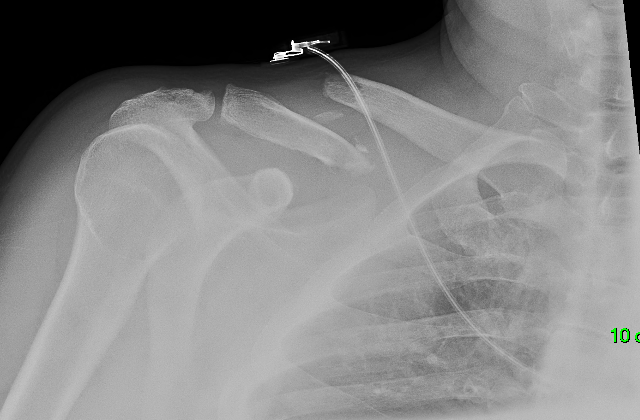

Other factors your surgeon will consider is your age, the location of the fracture and the presence of shortening. Patients under the age of 16, in general, do very well with non-surgical management and so are usually treated in a sling. Patients over the age of 60 usually have lower demands for their clavicle and so again are usually treated non surgically. The debate regarding treatment is mainly for the patients between these ages.
Most fractures will occur in the middle part of the clavicle, the so called mid shaft. Fractures occurring at the outer or inner end behave differently and are more likely to require surgery. Shortening of the clavicle is important to determine as this may lead to shortening of the “front strut” of the shoulder, which consequently allows the shoulder blade to fall forward (protracted). Anyone who has read my other blog on “Why Gorillas can’t throw” will know that having a protracted shoulder blade is a bad thing! The medical evidence supports surgery for clavicle fractures with greater than 2cm shortening.
While surgery is safe there are always potential complications that can occur. This is why the decision of how to manage your fracture should be a shared decision between you and your surgeon. Your views and your surgeon’s views are important at arriving at the right decision for you.