
Osteoarthritis (OA) of the knee is the most common progressive musculoskeletal disease – over 250 million patients worldwide are affected.
The main treatment option for established knee arthritis hasn’t changed much since the early 1970s with the advent of total knee replacement implants (made from metal alloys and plastic – mainly cobalt-chrome and polyethylene) that were similar in design to those used today. Partial knee resurfacing options (and even smaller focal implants) have been developed to replace more limited sections of the joint, but it could be argued that these artificial joints represent a failure of modern medicine to stop the disease process of arthritis in its earlier stages and therefore to avoid invasive replacement surgery.

Model of knee showing progressive arthritis and standard knee replacement.
Osteoarthritis is a complex and varied entity. Often referred to as “wear and tear” arthritis, some patients will have had an injury to the joint surface which causes progressive loss of the cartilage covering, or will have overloaded the joint with excess repetitive impact or obesity, but many sufferers have no obvious cause for their progressive joint damage.
A lot of research time, effort and money has been put into gaining a better understanding of the causal factors that influence the development of OA, and this has provided doctors with new biological (non-surgical) treatments that could have the potential to slow or even reverse its progression. Broadly grouped as “stem cell therapies”, these include platelet-rich plasma (PRP), cells taken from bone marrow, and microfragmented adipose tissue (fat cells) taken from the abdominal wall.
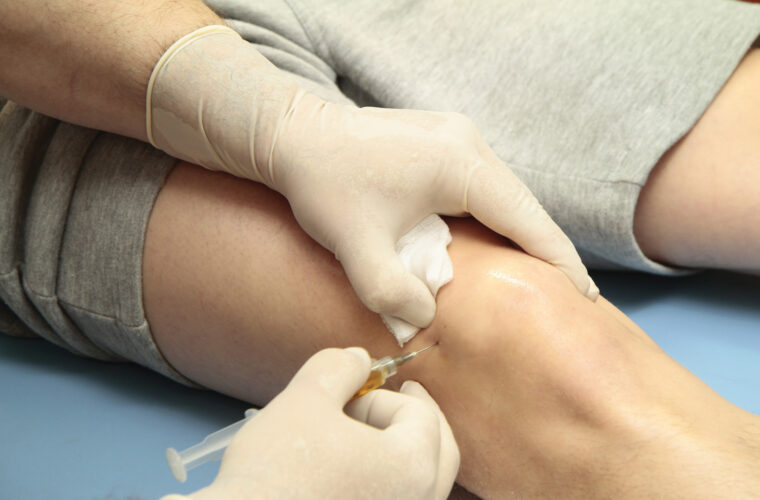
PRP injection into knee.
All of these can be injected into an arthritic joint, and have been shown to reduce pain and inflammation for a few months, but published evidence so far is limited to small trials in selected groups of patients without longer term follow up. The injections appear to be safe, but in order to truly determine their benefit, longer-term trials that are “blinded” to take into account the placebo effect are needed.
These injectable biologic treatments are generally not available on the NHS (due to lack of evidence of cost-effective ongoing benefit), but are offered by some private clinics using advertising that doesn’t always match reality for the majority of patients who might be tempted – claims of “cartilage regeneration” are unrealistic for patients with bone-on-bone arthritis, who are likely to be both disappointed and several thousand pounds poorer.
For now, joint replacement surgery for established arthritis remains the gold standard to which other treatments should be compared, but the momentum behind biological therapies for patients with earlier stages of cartilage damage is increasing. OA is not a single disease entity so it is unlikely that one treatment modality will work for all, but a better understanding of the processes that lead to joint inflammation and cartilage damage are likely to provide clinicians with treatment options in future that may eventually herald an end to the era of artificial joint replacement surgery.