
Partial knee replacement – could this be the right option for you?
Knee arthritis occurs when the cartilage layer protecting the bones gradually wears away, leading to pain, swelling and stiffness. Many studies have shown that around 1/3 of patients with knee arthritis only have damage in one section of their knee, and therefore could be suitable for a partial knee replacement (or “unicompartmental” knee replacement).
In the UK (and most of the world), almost 90% of knee replacements are “total knee replacements”, where all the surfaces of the knee joint are replaced with metal and plastic components. Generally the results are good, but some patients are left dissatisfied, and it is common for patients to describe their knee as feeling noticeably “artificial”, even after full recovery.
Many of these patients are not being offered a smaller operation that has clear potential advantages.
Your knee is divided into three main sections (or compartments) – the medial (or inner) compartment, the lateral (or outer) compartment, and the patellofemoral (or anterior compartment) between the kneecap and the thigh bone. Each of these sections can become damaged by arthritis in isolation, and therefore be suitable for a partial knee replacement – an alternative for patients whose disease is limited to just one area of the knee.

A partial knee replacement.
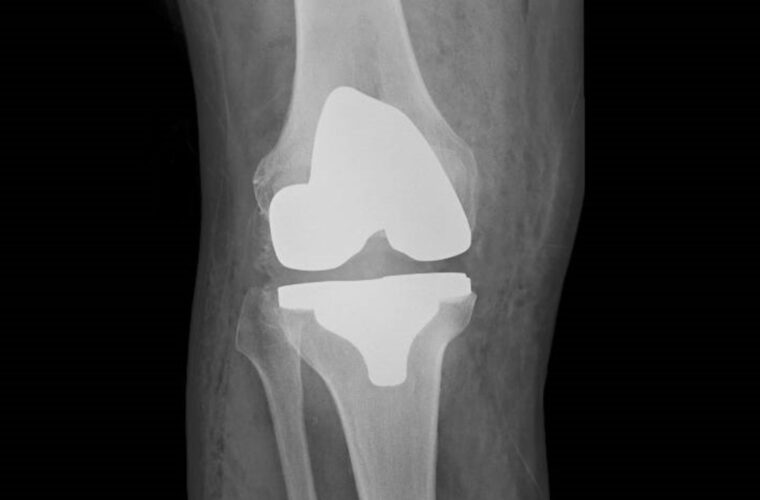
A total knee replacement.
Because a partial knee replacement is done through a smaller surgical opening (known as “minimally-invasive surgery”), and there is less disturbance to the internal tissues, patients will usually find recovery is easier, and will return to normal activities sooner than patients having a total knee replacement. The potential advantages of partial (over total) knee replacement include:
- A significantly lower risk of surgical complications.
- Quicker recovery with a shorter hospital stay (typically 24 hours).
- Less pain after surgery and earlier return to normal activities.
- A better range of knee bend and better ability to kneel.
In addition, because the cartilage in the unaffected sections of the knee is not removed and no ligaments are cut, many patients report that a partial knee replacement feels more natural than a total knee replacement.
It is crucial that the correct assessment is done to decide if you are suitable for this smaller operation. This includes a full set of Xrays taken with you standing, a careful clinical examination by a surgeon who has experience of the different options for your knee, and sometimes an MRI scan to confirm the cartilage damage pattern.
Partial knee replacement is not suitable for patients with significant knee stiffness, deformity which cannot be corrected, inflammatory arthritis, or ligament damage – if the criteria are not carefully applied, then there is a higher risk that you would need further surgery in the future (conversion to total knee replacement) for arthritis developing in the other sections of your knee.
With careful patient selection, partial knee replacements have been shown to have excellent medium and long-term results in all age groups of patients considering knee replacement surgery.