
This article provides a summary of the available evidence for how to prevent knee injuries with some useful links.
Knee injuries (such as Anterior Cruciate Ligament (ACL) tears) are common, typically occurring when a person is pivoting, cutting, or landing aggressively – movements that are standard in many sports including football, netball and basketball. These injuries often require surgery, and result in considerable time off sport and work for extensive rehabilitation.
Orthopaedic surgeons are trained to treat your injuries, and we enjoy doing it. ACL reconstruction surgery is one of my favourite operations and gets good results with most returning to full contact sport.
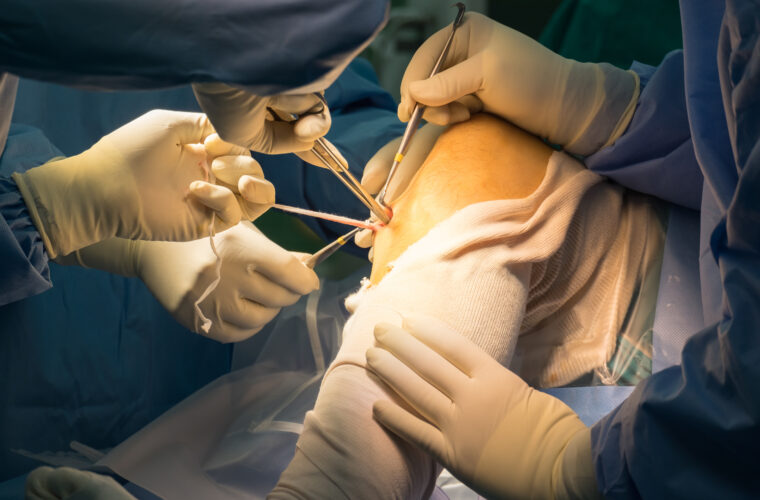
image of hamstring tendons being prepared for ACL reconstruction surgery.
But many of these injuries are preventable….
Since the increase in female participation sports that occurred in the 1970s, it has long been known that women had a higher risk for ACL injury – thought to be due to differences in knee anatomy, muscle strength and control, and hormonal influences on ligaments. They are also more likely to have “dynamic knee valgus” – a term given to the way the knee can drop towards the midline when landing from a jump with the hip also twisting inwards. This movement pattern is a proven risk factor for knee injuries (in particular ACL rupture), and is a good way for sports coaches and physios to quickly pick out those at highest risk (carefully observe a 1-legged squat, or use the “drop jump test”).

Dynamic knee valgus.
If this is how you land from a jump, you are at high risk of knee injuries.
Football
In 1999, a team of experts at the Santa Monica Orthopaedic and Sports Medicine Research Foundation developed a training programme which they named PEP – Prevent injury and Enhance Performance. It is a highly-specific programme that was designed to reduce the risk of ACL injury in female teenage football (soccer) players which takes 15 minutes and replaces the traditional warm up – these are their original instructions: PEP Program (aclstudygroup.com)
The research team implemented this training in 52 teams (1041 female subjects aged 14-18) and compared their injury risk in the subsequent football season with 1902 players participating in the same league who had no specific training (a control group). And the results were astonishing – just 2 ACL confirmed tears in the trained group, vs 32 tears in the untrained group. The untrained group was nearly twice the size, but this still gave a reduction of 88%. They followed the teams for another season, and again showed a highly significant reduction in ACL injury risk of 74% in the second year. For such a simple intervention in amateur athletes, these results were remarkable. If you want to read their full paper click here: PEP Program Study – LA84 Foundation
This type of training programme (which includes a warm-up, stretching, strengthening, plyometrics, and sport specific agilities), increases flexibility and reduces the dynamic knee valgus and therefore helps to avoid vulnerable knee positions. It can be done on a field, requires no special equipment, and should be undertaken 2 – 3 times per week for full effect.
The programme has been further developed by FIFA, who published guidelines aimed mainly at adolescent footballers in 2017. The full guide ( 11 plus workbook ) – includes many more pictures of dynamic knee valgus. There is also a useful series of videos which are free to access – The “11+” Warm-up: Part 1 – YouTube
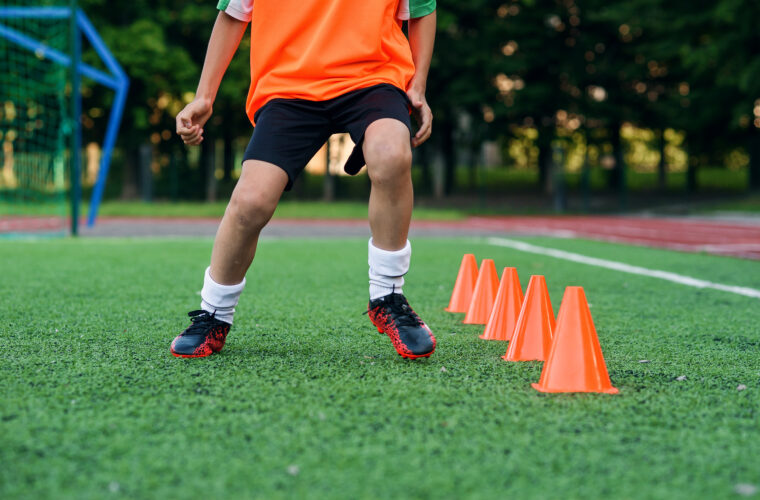
Cutting sideways with balance control during football training.
But what about other sports? And can this training help avoid other injuries? …
Rugby
The Rugby Football Union (RFU) has developed a wider programme of injury prevention in rugby, especially for teenagers and young adults. Again it includes balance training, whole-body resistance training, plyometrics, and controlled rehearsal of landing and cutting manoeuvres. They have published training interventions tailored for age groups from U15 to adult that can be downloaded from the RFU website here: englandrugby.com
The evidence of the benefit of this specific programme goes beyond knee injuries: A research study which introduced this into schools (and compared this to a standard programme of warm-up exercises), showed an impressive 72% reduction in match day injuries – including upper limb, lower limb and concussion.
Netball
Netball has one of the highest rates of ACL injuries in any sport (and, like volleyball, attracts a disproportionate number of tall participants who are more likely to have dynamic knee valgus). This is another example where sports federations have taken the information originally gained from the PEP programme which started 20 years ago and developed specific injury prevention guidelines – here is another good example:
Netball Smart – Official injury prevention programme of Netball New Zealand
So, if you (or your teenage children) participate in sports that include dynamic twisting movements, or you are involved in coaching these sports, then you need to make sure you put these injury prevention programmes into your team warmup routines – they can make a big difference.